Wes Sherman Writes His Name |
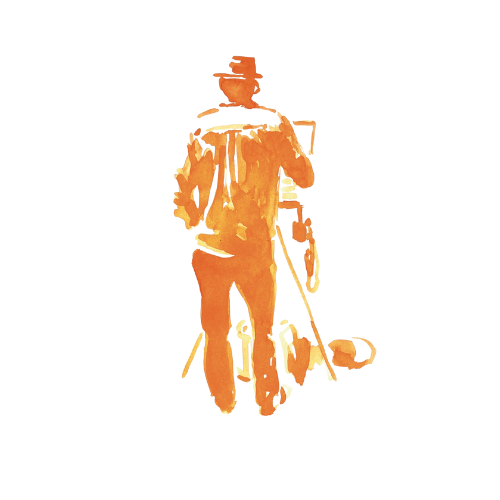
Wes Sherman is an abstract painter making landscapes. Or maybe he’s a landscape painter obsessed with Abstract painting. Follow Sherman’s process in the latest graphic exploration by artist, Joseph Christy. Using both photos of Sherman’s paintings and comic panels to explore, Christy crafts a book both of process and personality. For both art lovers and comic book enthusiasts. Experience painting through a very personal lens.
Protein in Your Painting
|
Protein in Your Painting |
The soul of the work lies at the moment you take in a breath, slowly releasing the warmth while intentionally incorporating the haikus and poems with visual perceptions/concepts of art. Protein in Your Painting was carefully crafted by the creative authors and artists Wes Sherman and Gretchel Hathaway and edited by Adam Remeniski. Protein is the unique micro-nutrients of a visual piece. When you come to the end of the book, you will realize the reading is not over - the moments are inside you. Treat yourself to starting over and experience new deeper moments to ponder.
Exhibition Books
|
Exhibition Books |
Books by Wes Sherman and collaborators containing collections of paintings and drawings from various exhibitions and galleries.
-
This is True, a book of drawings done by Wes Sherman, presented by K. James Gallery.
-
Art by Terri Fraser and Wes Sherman for their solo exhibitions ‘Horizon,’ presented by Pictor Gallery. Terri Fraser and Wes Sherman’s art explores the relationship the artist has with nature, and how the “Horizon” cannot be possessed by any individual but only experienced and interpreted.
-
Catalog of art from the exhibition Cloud: Some of Her Names, featuring work from Terry Thacker, Wes Sherman, and Adam Remeniski. Extensively pictured, this catalog is illustrated with twenty-five paintings, clustered into twelve stations with many painting details as well as photographs of the artist’s studio. A round table discussion with three other artists and two brief, reflective essays accompany the exhibition.
Sediment and Structure, Air and Memory:
A Painting Pilgrimage
I made the trip into New York City to see these two exhibitions. Living in Hackettstown, New Jersey, I don’t go into the city casually. This was a deliberate pilgrimage—with studio questions in mind, seeking to stand in front of paintings where materials matter.
The drive in from exurban NJ felt like a transition of tempo: highways narrowing into tunnels, distance collapsing into density. By the time I parked and caught the subway at Hudson Yards, I was already shifting gears—from daily logistics to looking. The train carried me north to the Upper East Side, where Jasper Johns’ paintings were installed at Gagosian Gallery.
I’ve been planning my trip for weeks specifically to get to this exhibition. Standing in the rooms of the gallery, scale hit me first. For the most part, the paintings are large—commanding walls, holding space with a physical authority that you feel in your body. I had to step back, then forward, adjusting distance just to take them in. And then the surfaces began to speak. Johns’ materials don’t open easily; they resist. Encaustic holds light in a waxy suspension. Oil drags. Grit interrupts the eye. The crosshatch structures feel engineered, constructed through pressure and revision. I found myself slowing down, wanting to get close enough to read the surface like terrain. These paintings insist on their objecthood. They carry the evidence of making layers pressed into place, decisions buried and revealed. Material isn’t a vehicle for image; it’s the site where the thinking happens.
Leaving uptown, heading downtown, the rhythm changed. The daylight changed. My body was still calibrated to monumentality and density and carried that weight with it. By the time I reached the Lower East Side to see Ewelina Bocheńska’s paintings at J.J. Murphy Gallery, my eyes were still expecting expansiveness.
But Bocheńska’s paintings met me differently. Her paintings are small. Intimate. I had to lean in instead of stepping back. The shift in scale immediately changed the pace of looking—quieter, closer, more personal. Where Johns compresses, she releases. Her surfaces breathe. Pigment hovers and settles like atmosphere rather than mass. Layers veil instead of encrust. Edges dissolve into light and distance. I wasn’t squinting at resistance; I was moving through space. Her paintings felt less built than weathered—less constructed than accumulated. If Johns makes material feel like sediment and structure, Bocheńska lets it feel like air and memory.
My bodily experience shifted with the scale. Johns’ large works engaged me physically; my eyes traveled across distance and then burrowed into texture. With Bocheńska’s smaller works, my body stilled. Vision narrowed and softened. One encounter expanded outward into space and weight. The other drew inward into intimacy and suspension.
And yet, moving between them in a single day, I felt a deep kinship. Both artists let process remain visible. Both treat surface as a record of time. Repetition organizes each body of work—Johns through the disciplined lattice of crosshatching, Bocheńska through recurring gestures and tonal rhythms that quietly structure the field. In both exhibitions, materials carry meaning. Substance is never neutral.
Traveling back home, I kept thinking about how differently paint can present—and how scale amplifies that thinking. Johns’ anchors perception in matter—large, dense, resistant, undeniable. Bocheńska opens perception into atmosphere—small, porous, luminous, unfolding. One condenses experience into substance. The other releases it into sensation.
Two shows. One day. A city crisscrossed by subway lines and studio questions; a through line of material intelligence stretching across scale, surface, and sensibility and following me back home.
Wes Sherman (March 7, 2026)
Stress Under Tension: Bodies, Objects, and the Shape of Movement
A critique of Stress Curves at M Galleries
In their two-person exhibition Stress Curves, Jane Westrick and Josh Araujo approach a shared set of concerns—time, motion, and material intelligence—from strikingly different artistic languages. Seen together, their work proposes that movement is not only something bodies perform but something matter itself remembers, resists, and records.
Westrick’s paintings begin in choreography but refuse to end there. Drawing from the codified world of ballroom dance, her paired figures hover in states of negotiated balance—caught between lead and follow, structure and improvisation. The expected polish of performance gives way to friction. Arms reach not toward display but toward adjustment; torsos torque subtly as if testing the limits of prescribed roles. What emerges is not spectacle but rehearsal—the vulnerable space where identity is practiced rather than presented.
Time in Westrick’s work unfolds sequentially. Each painting feels like a suspended frame within a longer phrase of movement: a step initiated, a weight shift nearly resolved, a turn implied but incomplete. Viewers mentally animate the figures, reconstructing what came before and anticipating what follows. This temporal elasticity opens a conceptual dimension: choreography becomes social metaphor. Systems of order—gender roles, partnership conventions, traditions of poise—are neither rejected nor obeyed but gently stressed. The paintings ask what happens when inherited structures are inhabited sincerely yet bent toward more fluid possibilities.
Material plays a quiet but decisive role in this destabilization. Working in acrylic and pastel on paper as well as oil on paper, Westrick leverages the absorbency and immediacy of paper surfaces to preserve touch, drag, and revision. Pastel’s particulate softness allows color to hover and smear like afterimages of motion, while acrylic and oil alternately stain and sit atop the surface, creating shifts in tempo between translucence and weight. The tactile vulnerability of works on paper reinforce the sense of rehearsal and contingency: gestures feel tested rather than monumentalized. Material here behaves like choreography itself—responsive, revisable, alive to pressure.
Araujo’s contribution operates in a different register. Where Westrick’s motion is embodied, Araujo’s is structural. His sculptures translate kinetic energy into geometry, balance, and material encounter. Lines press against edges; planes meet at uneasy angles; forms appear held in place by forces we cannot see but can intuit. Motion is not depicted but latent—stored as tension within relationships between parts.
If Westrick’s time is cinematic, Araujo’s is durational. His works do not imply before-and-after so much as sustained presence. The viewer’s experience unfolds through slow looking: shifting vantage points, recalibrating spatial assumptions, noticing how weight distributes and how surfaces assert themselves. Materials are not neutral carriers of form but active agents in the work’s meaning. Glazed ceramic alternates between brittle delicacy and geological permanence; high-density foam introduces industrial lightness and compressibility; acrylic sheet captures and redirects light as a structural element. Thread—nylon or upholstery—acts both as connective tissue and drawn line in space, suturing components while foregrounding acts of joining.
Elsewhere, the material vocabulary becomes more eccentric and more vulnerable: tulle, wool roving, found plastic mesh, silicon rubber, mahogany, and flashe paint create tactile shifts between soft and rigid, porous and sealed, organic and synthetic. Particularly resonant are inclusions such as spent shiitake mushroom blocks, used floral foam, and the chrysalis of a lunar moth—materials already marked by prior life cycles and transformations. These elements carry time within them. They sag, crumble, harden, or preserve; they insist that sculpture is not only constructed form but accumulated duration. Araujo’s objects feel less assembled than negotiated, as if each material brings its own will, its own stress tolerance.
What unites the artists is a sensitivity to stress as a generative condition—and to material as the medium through which stress becomes visible. In Westrick, stress is social and corporeal: the productive strain between prescribed movement and lived expression, registered through smudged pigment, layered strokes, and the receptive tooth of paper. In Araujo, stress is physical and spatial: forces held in equilibrium, tensions distributed across joins, weights countered through structure and substance. Both treat tension not as breakdown but as structure’s expressive limit, the point where systems reveal their flexibility.
Their shared artist statement describes the exhibition as “a type of truth in pageantry, a show of pomp in response to societal and material pressures.” That phrasing resonates deeply across both practices. Westrick’s dancers perform pageantry while quietly undoing its codes; Araujo’s sculptures stage material theatrics where balance and poise are hard-won achievements. Pomp becomes a surface condition stretched over pressure. Display becomes evidence of strain.
Their differences sharpen this dialogue. Westrick’s figuration invites empathetic entry; we read bodies as proxies for ourselves, decoding gesture as emotion and relationship. Araujo withholds narrative cues, asking viewers to engage perceptually rather than psychologically. One artist works through the allegory of the body: the other through the poetics of objects. Yet both insist that motion is relational—emerging between partners, between materials, between viewer and form.
Stress Curves ultimately suggests that movement is less about speed than about responsiveness. A body adjusts to another body. A material yields or resists force. A structure holds—until it doesn’t. In this shared inquiry, Westrick and Araujo map different arcs of the same phenomenon: how form bends without breaking, how matter carries memory, and how meaning lives in the curve where pressure becomes expression.
Wes Sherman (March 15, 2026)